
Criminal Cases in Champaign County Courts
Champaign County sends felony, misdemeanor, traffic, and ordinance prosecutions to the Champaign County Circuit Court. The county belongs to Illinois's Sixth Judicial Circuit and Fifth Appellate District. Champaign, Urbana, and Rantoul do not operate separate municipal criminal courts. A city police arrest can therefore lead to a county court file, while the police report stays with the arresting agency.
The Circuit Clerk keeps the docket, charging papers, orders, judgments, and financial assessments. The State's Attorney makes charging decisions, and the court hears the case. Current judge and courtroom assignments can change. Use the official court orders rather than an old room number. The clerk also makes clear that its files are not police reports and do not amount to a statewide background check.
One Champaign County Court Clerk
An Urbana Police arrest, a Champaign Police citation, and a Sheriff's felony investigation can all lead to Champaign County criminal court records held by one clerk. Yet the arresting agency still owns its incident narrative, body-camera material, and evidence. A police case number and a Circuit Court case number identify different records.
The Clericus Magnus public portal is the local court index. Its official landing screen shows the system used for Champaign County criminal case searches.
The portal is the best first stop, but the clerk remains the source for the actual document and any certified copy.
How to Search Case Records
Begin with the Circuit Clerk's official site and choose “View Public Court Case Information.” Clericus Magnus supports two verified modes. Search by participant name when the number is unknown, or use the exact case number when known. The research did not verify birth-date, wildcard, export, or date-range controls, so do not assume those filters exist.
- Open the clerk's public case information link and launch Clericus Magnus.
- Choose Participant Name or Case Number, then enter the most exact value available.
- Compare the case number, dates, and charge context before accepting a name match.
- Read the event chronology and newest docket note. Do not infer an outcome from the first charge.
- Request pleadings, final orders, or certified copies from the clerk when the index is not enough.
| Field Label | Type | Required | Notes |
|---|---|---|---|
| Participant Name | Mode and text | One mode | Use when the case number is unknown. |
| Case Number | Mode and text | One mode | Use the exact court number when available. |
| View Public Court Case Information | Launch action | No | Clerk button that opens the portal. |
Note: A similar name is not enough; compare court numbers, filing dates, and charge context before treating a result as a match.
Order Champaign County Court Records
An online docket is an index, not a full document set. Use the clerk's criminal document and record search form to order a complaint, information, indictment, sentencing order, financial assessment, or other named filing. The form asks for full legal name, birthdate, contact details, years searched, record type, and search details.
The search fee is $10 per year. Certification costs $5 per document. Copies begin at $2 for the first page, followed by lower per-page rates. The official wording differs slightly near page 19 or 20, so ask for an advance quote. The official request page shows the route.
Choose the request category carefully. Criminal, traffic, and ordinance records are separate choices. Include the filing or arrest year, exact document title, number of copies, and whether certification is needed. The clerk quotes the total before advance payment. A broad name search across many years costs more because the fee applies to each year searched.
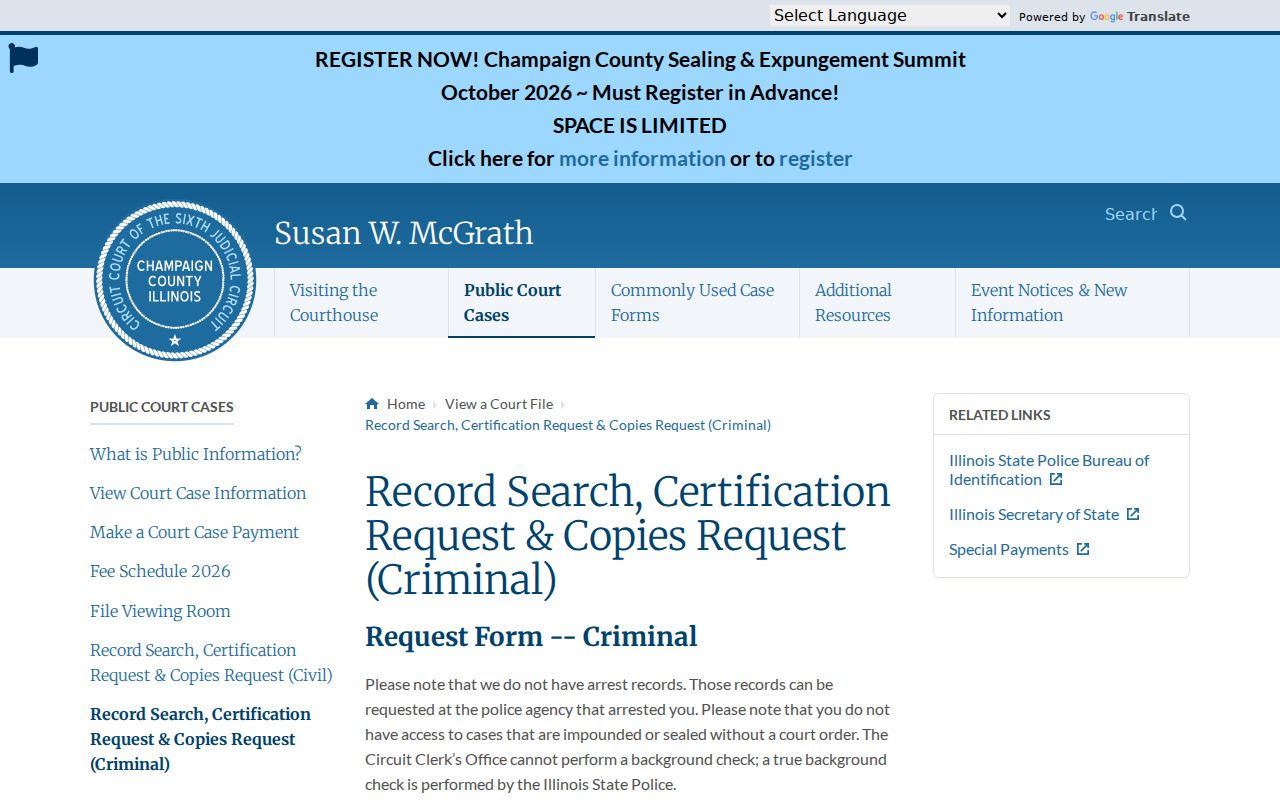
Exact case numbers and document names help staff quote the right search, copy, and certification cost.
What the Case File Shows
A Champaign County criminal case file records what happened after prosecutors filed a charge. “Pending” means unresolved, not guilty. “Disposed” means an outcome was entered, but the final order must be read to learn whether it was a conviction, dismissal, acquittal, supervision, or another result.
| Case Number & Court | The unique court file identifier and Circuit Court assignment. |
|---|---|
| Charging Document | The complaint, information, or indictment stating filed allegations. |
| Docket Entries | The dated register of filings, hearings, rulings, and scheduled events. |
| Hearing Dates | Past events and upcoming dates in current docket notes. |
| Disposition & Judgment | The result of each charge, which may differ from the initial allegation. |
| Sentence & Conditions | Custody, probation, financial assessments, and other court-ordered terms. |
Police narratives, evidence, exhibits, and transcripts are not part of the clerk's ordinary file. Ask the arresting agency for its report. Court reporters handle transcripts. Keeping those channels separate avoids asking one custodian for a record it does not hold.
Older Champaign County Case Files
The courthouse File Viewing Room is the fallback when an older Champaign County criminal case does not appear online. The clerk retains paper, digital, and microfilm material, including late-nineteenth-century records. An online miss can reflect age, spelling, indexing, or restricted status. It does not prove no case exists.
Bring photo identification for a physical file. Staff retrieve records and make selected copies, but they cannot interpret a docket or give legal advice. Visitors may not disassemble, remove, alter, photograph, or scan documents. Clerk-provided markers or paperclips identify pages for copying.
Stages of a Criminal Case
A Champaign County matter may begin with arrest or notice to appear. The State's Attorney reviews the facts and decides what to file. An initial appearance addresses custody and release. A felony can pass through a preliminary hearing or grand-jury indictment before arraignment. Discovery and motions follow, then a plea or trial, judgment, sentence, and possible appeal.
Case flow: Charges Filed › Arraignment › Pretrial › Plea or Trial › Disposition › Sentencing
The charge at booking may not match the filed count. Supervision is an Illinois result in which judgment may be withheld while conditions are completed. Read the final order instead of treating an arrest label or first docket entry as the outcome.
Arraignment is the hearing where the charge is formally addressed and a plea is entered. A disposition is the final outcome of a charge. “Nolle prosequi” means the prosecutor formally chose not to proceed. An acquittal is a not-guilty result after adjudication. These terms carry different meanings, so a docket summary should preserve the clerk's exact result instead of reducing every closed case to a conviction.
Champaign County Drug Court Records
Champaign County Drug Court has operated since 1999. Its team includes the judiciary, State's Attorney, Public Defender, Court Services, Sheriff, treatment providers, and community partners. The program combines supervision, testing, treatment, incentives, sanctions, and support. Official materials include assessment and consent forms, a handbook, and graduation requirements.
The underlying criminal case remains in Circuit Court. Public filings follow the same access rules, while treatment or protected health details may be confidential. Do not assume every specialty-court document appears online.
Assessment and graduation materials describe the local program, but they do not prove that any named person entered or completed it. The court docket and signed orders remain the proper sources for an individual case. This distinction protects accuracy while still showing how Champaign County's specialty program fits within the ordinary criminal court file.
After Champaign County Sentencing
A state-prison sentence moves a custody search beyond the county clerk. The IDOC Individual in Custody Search covers Illinois prison custody and may show supervision status. It does not replace the Champaign County judgment. County probation is also distinct from IDOC parole or mandatory supervised release.
The official IDOC hub shows the state search route that can follow a Champaign County conviction.
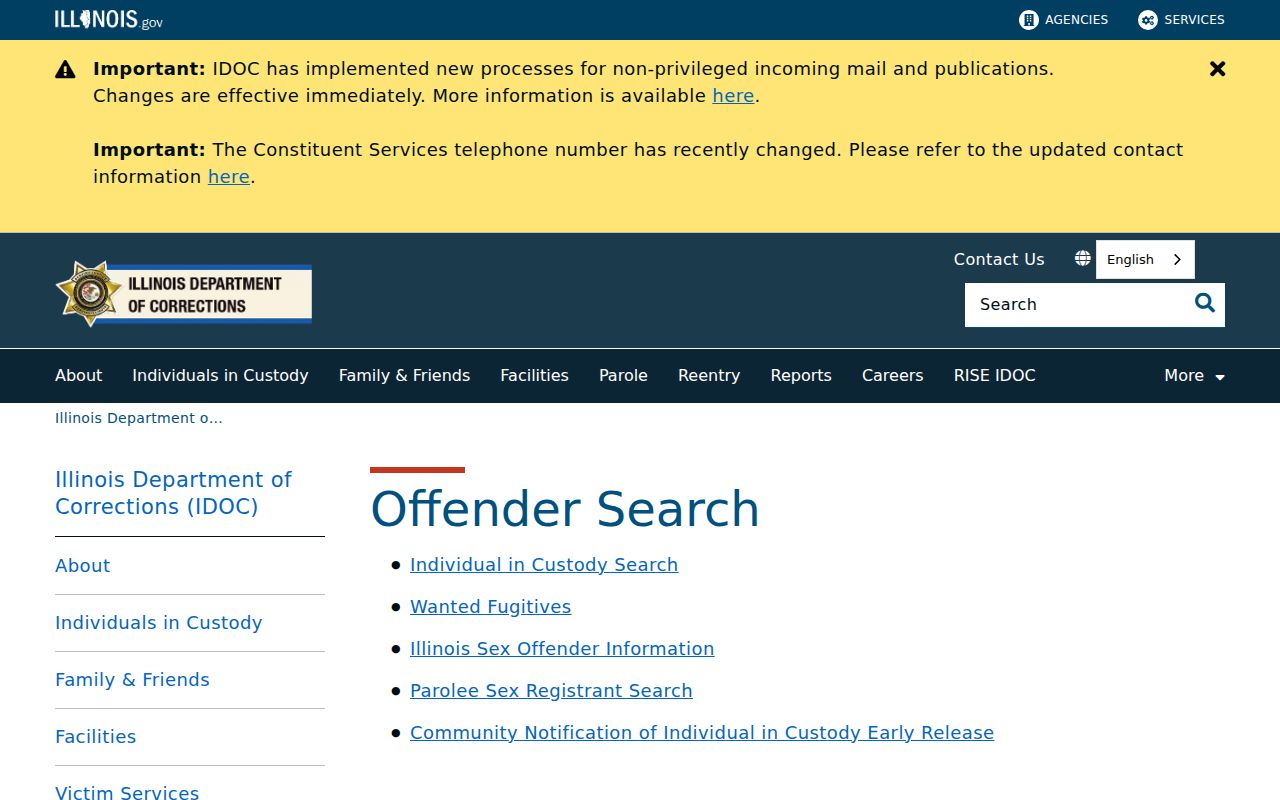
Use the court file to confirm the sentence, then use IDOC only for current state custody or supervision information.
Champaign County Case Access Restrictions
Illinois excludes sealed, expunged, impounded, and confidential material from ordinary electronic viewing. Champaign County criminal court records may also hide juvenile matters, protected victim data, financial statements, medical information, Social Security numbers, and other private identifiers. A redacted online view may contain less than an authorized courthouse file.
The Illinois Supreme Court Electronic Access Policy governs those limits. Illinois FOIA does not override a sealing or impoundment order. If a case is missing, ask whether the number or spelling is wrong and whether public confirmation is allowed.
Adult expungement and sealing follow 20 ILCS 2630/5.2. Expungement generally destroys or returns eligible records, while sealing blocks ordinary public access but preserves access for authorized justice agencies. Eligibility depends on the full case history and outcome. Once an order is entered, processing can take time across the clerk, arresting agency, jail system, and ISP repository.